
On this page
For product teams and agencies, the bottleneck in shipping is rarely the code itself—it is the friction of translating messy, context-poor client feedback into actionable technical tasks. Marker.io and TellBack both aim to solve this, but they represent two different generations of feedback technology. Marker.io is a long-standing tool for visual bug reporting, allowing users to place 'stickers' and annotations directly on a webpage.
TellBack is a modern AI-powered feedback intelligence layer designed for teams that need more than just a screenshot. While Marker.io captures the visual 'what' of a bug, TellBack uses Generative AI to interpret the 'why' and the 'how,' transforming raw feedback into structured tasks and prompts for AI coding agents like Cursor or Claude Code. If your team is moving toward AI-assisted development, the choice between documenting a problem and automating its resolution has never been clearer.
The Core Difference: Annotation vs. Intelligence
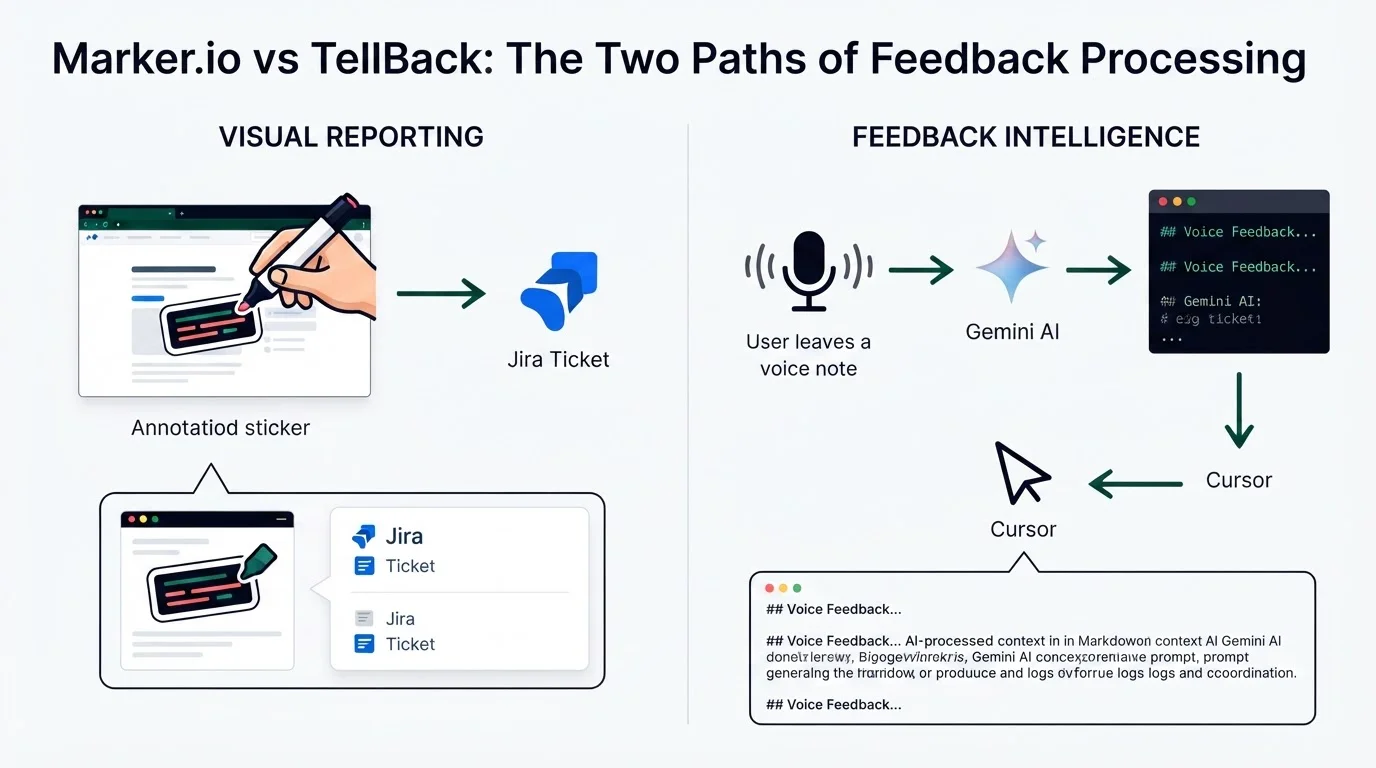
The primary difference between these platforms lies in the processing layer. Marker.io serves as a bridge between the reporter and the developer's issue tracker, focusing on visual clarity. TellBack acts as an intelligence filter, using AI to distill raw user signals into technical documentation that developers (and AI agents) can act on immediately.
| Feature | Marker.io | TellBack |
|---|---|---|
| Core Mechanism | Visual annotations & stickers | AI feedback intelligence layer |
| Input Types | Screenshots, session replay | Voice notes, clicks, context, text |
| AI Processing | Basic metadata capture | Generative AI (Gemini via Vertex AI) |
| Developer Output | Jira/Trello/Linear task | Dev-ready task + AI Coding Agent prompt |
| Projects | Tiers capped by project limits | Unlimited projects on all plans |
| Best For | Visual design review & UAT | AI-assisted development & triage automation |
Marker.io: The Standard for Visual Annotation
Marker.io has built its reputation on making website testing intuitive for non-technical users. It removes the need for long email chains by allowing users to click anywhere on a live site, draw on the screen, and submit a ticket directly to tools like Jira, Trello, or GitHub. This visual-first approach is ideal for User Acceptance Testing (UAT) and design-heavy reviews where a "pointing and clicking" workflow is preferred.
One of its standout features is Session Replay, which provides direct insight into user actions leading up to a bug. This helps developers see the exact path a user took, making it easier to reproduce elusive UI glitches. Additionally, Marker.io offers robust Data Masking capabilities, ensuring that PII (Personally Identifiable Information) is automatically scrubbed from screenshots and logs before they reach your issue tracker. This makes it a strong contender for teams working in regulated industries where privacy compliance is non-negotiable.
TellBack: The Intelligence Layer for Modern Builders
TellBack moves beyond simple reporting by acting as a filter for your engineering team. Instead of receiving a screenshot with a vague caption like "this doesn't work," TellBack captures the raw signal—including voice notes, selected DOM elements, and browser details—and uses Gemini models via Vertex AI to draft a structured task.
This platform is specifically designed to close the loop between human feedback and machine-assisted fixing. By capturing the full technical context of a user's friction, TellBack generates dev-ready tasks that include clear acceptance criteria and technical evidence. Because TellBack allows for unlimited projects across all pricing tiers, agencies and product teams can scale their operations without constantly managing project caps or seat-based billing constraints.
Zero-Prompt Engineering for Coding Agents
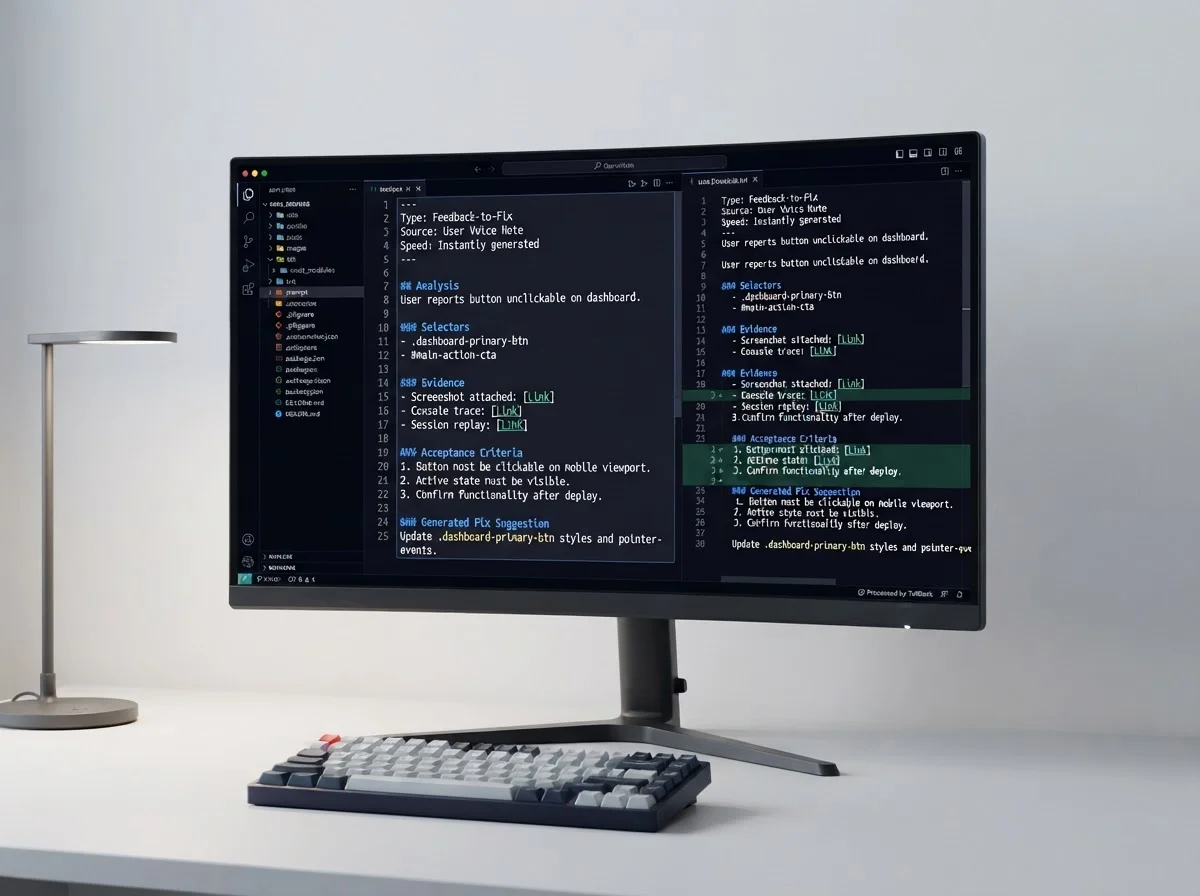
The most significant differentiator for TellBack is its native support for the growing ecosystem of AI coding agents. When a task is generated, TellBack creates a markdown prompt specifically formatted for tools like Cursor, Claude Code, or Windsurf. These prompts include selectors, technical evidence, and specific instructions that an AI agent needs to write a fix.
This effectively eliminates the manual triage phase. Instead of a developer spending twenty minutes interpreting a bug report, they can paste a pre-formatted prompt into their IDE and move straight to reviewing the code generated by their agent. This workflow shift is what defines TellBack as an intelligence layer rather than just a reporting widget.
Master client feedback and bug reports
Learn how to efficiently capture, understand, and act on client feedback and bug reports. Get strategies to streamline issue resolution for product teams.
Workflow Impact: UAT vs. Rapid Shipping
Deciding between these tools requires looking at where your team spends the most time. If your developers frequently ask, "Which browser were you using?" or "What did you click before this happened?", both tools will provide relief. However, the depth of that relief varies based on your tech stack.
Marker.io excels in traditional agency-client relationships. It is perfect for clients who need an intuitive, visual way to point out design discrepancies. The two-way sync ensures that when a developer closes a ticket in Jira, the client sees it as "Resolved" in the Marker.io widget. TellBack is optimized for shipping speed and automation. It is built for teams that are already leveraging AI to accelerate their development cycles. By transforming unstructured text and voice into structured markdown prompts, TellBack reduces the cognitive load on developers, making it the superior choice for fast-moving SaaS teams that need to triage high volumes of feedback quickly.
Pricing and Scalability for Teams
Marker.io pricing is based on seat counts and project limits, requiring teams to move between tiers to unlock more capacity. This model is common for traditional SaaS tools but can create friction for agencies managing dozens of small client projects simultaneously.
TellBack offers a more flexible entry point for individual builders and growing agencies. The Freelance plan at $29/mo includes 1 seat and unlimited projects, ensuring you never have to choose which client site gets feedback capabilities. For larger teams, the Studio plan at $79/mo includes 15 seats and unlimited projects, while the Agency plan at $149/mo adds advanced white-label configurations and dedicated engineering support. This flat project pricing makes TellBack a more predictable expense as you scale your client list.
Frequently Asked Questions
Q: Does TellBack support visual screenshots like Marker.io?
Yes. TellBack captures screenshots, selected elements, and page context, but it adds an AI layer to interpret those visuals into structured technical tasks.
Q: Can Marker.io generate prompts for AI coding agents?
No. Marker.io is focused on human-to-human communication. While it captures metadata, it does not structure feedback into prompts for tools like Cursor or Claude Code.
Q: Which tool is better for non-technical clients?
Marker.io is designed for very non-technical users who prefer drawing on a screen. TellBack is better for teams that want to use voice notes and high-context logs to speed up the actual development work.
Q: Does TellBack integrate with existing issue trackers?
Yes. TellBack creates dev-ready tasks that can be pasted or synced into your existing workflow, with the added benefit of AI-drafted markdown prompts for your IDE.
Conclusion: Choosing Your Feedback Engine
The choice between Marker.io and TellBack comes down to whether you want to document feedback or automate the resolution of it. Marker.io remains a powerful choice for visual design feedback and traditional QA workflows where human oversight is the primary driver. However, for teams building in the age of AI, TellBack offers a clear technical advantage. By providing an intelligence layer that turns messy client noise into structured technical signals, TellBack empowers developers to spend less time in their inbox and more time in their IDE. If you are ready to stop translating feedback and start shipping fixes, TellBack is the intelligence layer your stack is missing.