
On this page
For over a decade, Usersnap has been the standard for visual feedback, helping product teams replace vague emails with annotated screenshots. However, as development workflows shift toward AI-native tools and agentic coding, the definition of "actionable feedback" is changing. It is no longer enough to simply see a bug; developers now need the context to be parsed, structured, and ready for an AI agent to fix. This is the primary divide between Usersnap and TellBack.
While Usersnap has expanded into a broad product discovery suite—offering surveys, feature boards, and sentiment analysis—TellBack serves as a dedicated AI feedback intelligence layer. By transforming raw visitor input directly into dev-ready tasks and coding-agent prompts, TellBack eliminates the manual triage bottleneck that often stalls production cycles. This comparison explores the technical trade-offs, integration depths, and workflow efficiencies of both platforms to help you decide which fits your modern development stack.
At a Glance: TellBack vs. Usersnap
| Feature | TellBack | Usersnap |
|---|---|---|
| Core Focus | AI-driven task & prompt generation | Visual feedback & product discovery |
| AI Capability | Gemini-powered parsing into markdown prompts | Sentiment analysis & AI-assisted replies |
| Developer Output | Dev-ready tasks & Agent prompts (Cursor, Claude) | Annotated screenshots & technical metadata |
| Primary Audience | Developers, Agencies, AI-native teams | Enterprise Product & QA teams |
| Pricing (Starting) | $29/month | Bundled seat-based tiers |
| Integrations | AI agents, Markdown-based, PM tools | Jira, Azure DevOps, Linear (2-way sync) |
| Key Strength | Eliminates manual triage | Broad Voice-of-Customer suite |
Usersnap: The Enterprise Suite for Visual Discovery
Usersnap has evolved from a simple bug-reporting widget into a comprehensive Product Discovery and Voice-of-Customer (VoC) platform. The product is now geared toward helping product managers centralize feedback from multiple channels, including NPS surveys, CSAT microsurveys, and public feature request boards.
For enterprise environments, Usersnap offers significant governance and compliance features. Its platform includes two-way synchronization with Jira and Azure DevOps, where Usersnap enables users to modify field values of feedback items before sending them to the destination. This ensures that incoming bugs conform to a strict enterprise project structure. Additionally, Usersnap offers EU-based data hosting in Frankfurt and Ireland, a critical requirement for European compliance teams adhering to strict GDPR standards.
Visual Context and AI-Assisted Replies
The core of Usersnap remains its visual capture capability. Users can take annotated screenshots, record video, and automatically attach browser metadata and console logs. This "visual-first" approach is ideal for QA teams who need to see exactly where a UI element is breaking.
Usersnap's AI, branded as Airis, focuses on administrative efficiency. Airis automatically categorizes incoming feedback by topic, scores the user's sentiment, and lets users allow AI to provide the reply content based on the feedback and project context. This helps support teams close the loop faster, though it still requires a human to verify the output and manually convert these insights into technical requirements for the development team.
TellBack: The AI-Powered Feedback Intelligence Layer
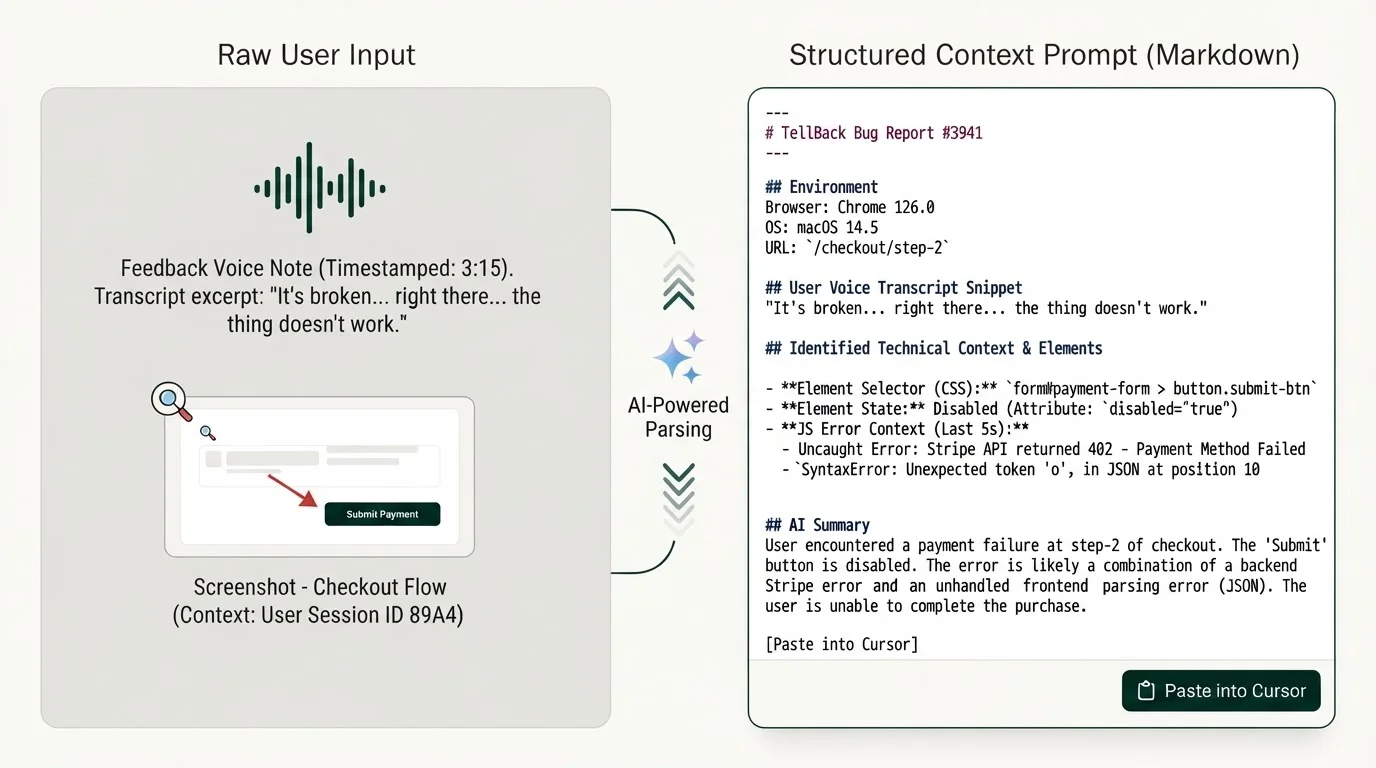
TellBack approaches the feedback problem from a fundamentally different angle. Instead of building a broad discovery suite, it focuses on the technical translation layer between a client's messy report and a developer's IDE. TellBack is designed for teams that prioritize "Time to Fix" over "Volume of Insight."
Using Gemini models via Vertex AI, TellBack parses raw visitor feedback—which can include voice notes, screenshots, and click paths—and instantly structures it into a dev-ready task. This goes beyond simple categorization. TellBack drafts the actual technical requirements, including element selectors, evidence, and acceptance criteria. For developers using modern AI assistants like Cursor, Claude Code, or Windsurf, TellBack generates a Markdown prompt that can be pasted directly into the agent to begin the fix immediately.
Eliminating the "Triage Tax"
In a traditional workflow, a bug report from Usersnap or an email still requires a Product Manager or Senior Dev to triage the issue. They must clarify the user's intent, identify the specific component affected, and write a clear ticket. This triage tax can consume hours of high-value time every week.
TellBack automates this transformation. When a user reports friction, the AI intelligence layer analyzes the safe error context, browser details, and visual evidence to draft the task. By the time a developer opens the report, the thinking work—identifying what is broken and how to describe it to a coding agent—is already done. This allows teams to ship client work faster and with fewer clarification loops.
Master client feedback and bug reports
Learn how to efficiently capture, understand, and act on client feedback and bug reports. Get strategies to streamline issue resolution for product teams.
Deep Integration: Enterprise Sync vs. Agentic Coding
A key differentiator is how each tool interacts with your existing stack. Usersnap focuses on maintaining a single source of truth for stakeholders through two-way syncs. It offers integrations with Trello, GitHub, and GitLab that have no limit for feedback senders and tickets, making it a robust choice for large organizations with rigid PMO requirements.
TellBack, conversely, is built for the agent-native development workflow. While it connects to project management tools, its primary integration is the portable Markdown artifact. Every task includes a prompt optimized for LLMs, including specific element selectors and execution steps. This reflects a shift in how modern software is built: where Usersnap helps you manage the ticket, TellBack helps you manage the code change. TellBack also enforces specific duration caps and rate-limits to ensure the widget maintains client application performance.
Scalability and Pricing Models
Pricing structures reveal who these products are built for. Usersnap utilizes bundled tiers that scale with both features and user seats, typically starting at an enterprise-ready price point. For larger teams, advanced technical features and custom legal terms move into custom enterprise pricing.
TellBack offers a more accessible entry point for agencies and independent builders. The Freelance plan is $29/month, while the Studio plan is $79/month and the Agency plan is $149/month. A significant advantage for TellBack is that the Studio and Agency plans include unlimited projects. This model is particularly valuable for agencies managing multiple client sites simultaneously without seat-based pricing constraints.
Decision Guidance: Which Platform Should You Choose?
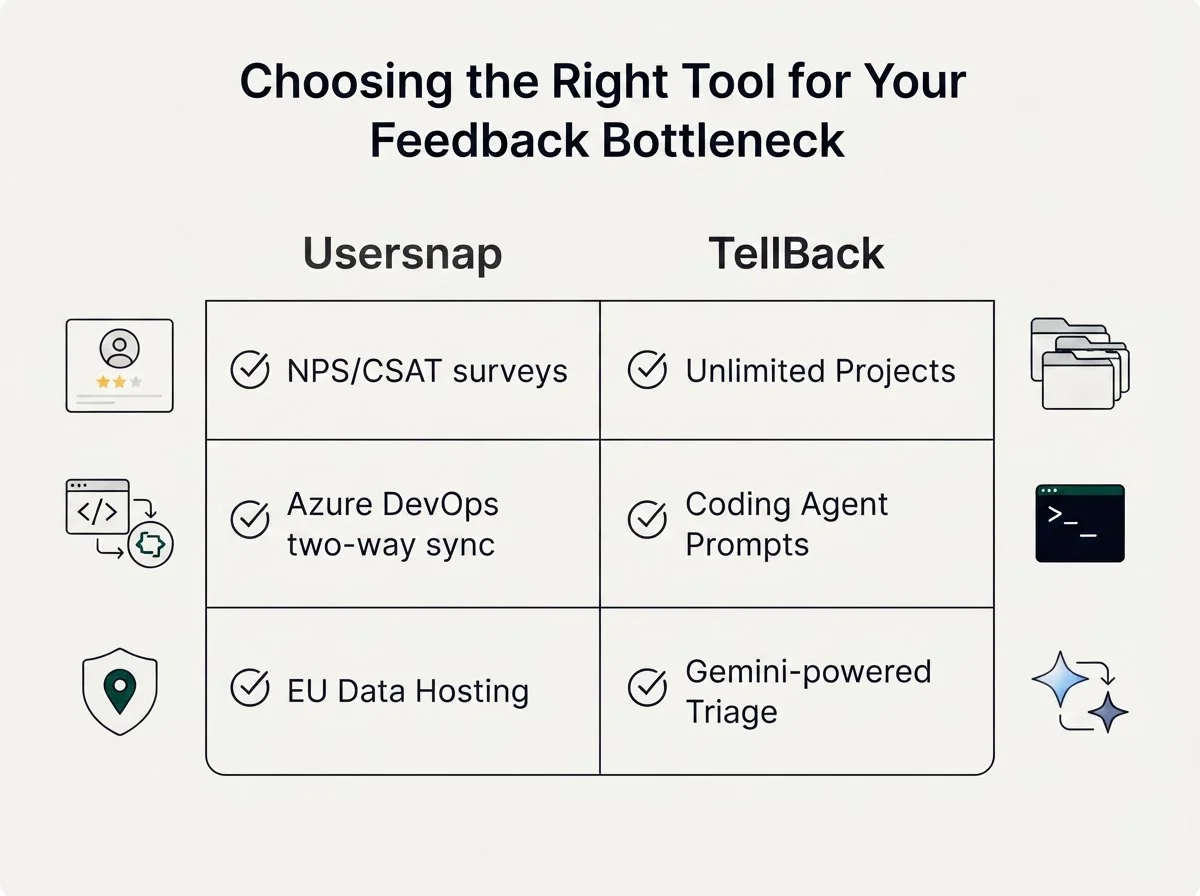
Choosing between Usersnap and TellBack depends on whether your bottleneck is discovery or execution. Both tools provide visual context, but their end goals differ significantly.
Choose Usersnap if:
- You are an enterprise product team that needs a central hub for NPS, CSAT, and broad feature requests.
- You require two-way sync with Azure DevOps or Jira to maintain status alignment between non-technical stakeholders and developers.
- You require strictly regulated EU data hosting and enterprise-grade SSO.
- You need a mobile SDK for capturing feedback within iOS and Android applications.
Choose TellBack if:
- You are a developer or agency looking to eliminate manual triage and move from a report to a fix in minutes.
- You use AI coding agents like Cursor or Claude Code and want prompts pre-filled with technical context.
- You manage multiple client projects and need a cost-effective plan with unlimited projects.
- You want a tool that drafts technical requirements including selectors rather than just delivering a static screenshot.
Frequently Asked Questions
Q: Can TellBack replace my project management tool like Jira?
No, TellBack is designed to sit between the user and your PM tool. It enriches the feedback into a dev-ready task that you can then push to Jira, Linear, or Trello, or use directly in your IDE.
Q: Does Usersnap offer AI parsing for bug reports?
Usersnap's AI (Airis) focuses on categorizing feedback and sentiment analysis. It does not currently draft full technical markdown prompts for coding agents like TellBack does.
Q: Is there a limit to how many projects I can have on TellBack?
The TellBack Studio and Agency plans include unlimited projects, making it a cost-effective choice for agencies managing high volumes of client work.
Q: Does Usersnap support mobile app feedback?
Yes, Usersnap offers a mobile SDK for capturing feedback within iOS and Android applications, whereas TellBack is currently optimized for web-based products and applications.
Usersnap remains a powerful choice for large organizations that need a structured, compliant, and multi-channel feedback system to drive product discovery. Its strength lies in its ability to integrate deeply with traditional enterprise project management workflows.
However, for teams that view feedback as a technical challenge to be solved rather than just an insight to be managed, TellBack is the superior alternative. By leveraging Gemini-powered AI to automate the translation of messy user input into structured, agent-ready tasks, TellBack reduces the cognitive load on developers and accelerates the entire shipping process. If you are ready to stop triaging and start shipping, TellBack provides the intelligence layer your modern stack is missing.