
On this page
Artificial intelligence is fundamentally altering how product teams interpret and act upon user feedback. For years, the feedback loop was a manual, fragmented process where raw user sentiment and bug reports were trapped in support tickets or disjointed Slack threads. The rise of AI feedback analysis marks a shift toward a more automated, context-aware pipeline that connects user friction directly to technical resolution.
Modern development teams no longer have the luxury of spending hours deciphering vague bug reports or "broken" status updates. By utilizing AI to parse unstructured data, teams can identify recurring themes, urgent technical failures, and high-priority feature requests with speed. This transformation ensures that product roadmaps are driven by high-fidelity data rather than intuition, allowing developers to focus on shipping code rather than hunting for context.
TellBack serves as a dedicated feedback intelligence layer, bridging the gap between a user's experience and a developer's environment. By capturing the full technical state alongside user notes, it transforms messy input into structured, dev-ready tasks. This approach enables agencies and product teams to close the loop faster and build products that are deeply aligned with actual user needs.
The Scaling Crisis of Manual Feedback Triage
Manual feedback analysis is inherently unscalable. As a product grows, the volume of incoming feedback increases, often leading to a backlog of duplicate reports and context-poor tickets. When a user reports that a feature is failing without providing browser specs, console logs, or a reproduction path, developers are forced into a costly cycle of back-and-forth communication.
This lack of technical context is one of the most significant barriers to efficiency. Without automated systems to capture the state of the application at the moment of failure, developers spend more time investigating the "how" and "where" of a bug than actually fixing it. Furthermore, manual triage is prone to human bias; different team members may prioritize feedback differently based on subjective interpretation rather than objective severity.
For agencies managing multiple clients, this problem is compounded. Managing feedback across various projects without a unified intelligence layer leads to fragmented workflows and missed insights. The traditional method of copy-pasting feedback into project management tools is slow, loses vital metadata, and fails to leverage the predictive power of modern AI models.
Administrative Bottlenecks in Issue Resolution
Effective feedback management requires more than just a collection tool; it requires robust administrative oversight. Product teams need the ability to manage workspace-level features, such as configuring Allowed Origins to ensure data is only collected from authorized domains. Without these controls, feedback streams can become cluttered with noise or irrelevant data from unauthorized environments.
TellBack addresses these operational hurdles by allowing teams to adjust active Feedback Modes and choose specific Visitor Identity Modes. These settings allow managers to tailor the data collection process to the specific needs of a project, whether they require anonymous sessions or identified user data. By providing a central dashboard for triaging bugs and viewing interaction streams, the platform ensures that the entire team—from PMs to engineers—remains aligned on current priorities.
The Power of AI in Understanding User Input
AI changes the feedback dynamic by automating the extraction of meaning from raw text, audio, and visual data. Natural Language Processing (NLP) allows systems to categorize thousands of comments into specific themes like "UI Friction," "Performance Issues," or "Feature Requests." This thematic extraction enables product managers to see high-level trends without reading every individual submission.
Beyond simple categorization, AI performs sentiment analysis to detect the emotional weight behind user input. A spike in negative sentiment regarding a specific module can serve as an early warning system for a regressive bug. By processing these signals in real-time, teams can respond to critical failures before they impact a larger portion of the user base.
Integrating AI into the feedback loop also allows for the generation of automated summaries. Instead of presenting a developer with a raw transcript, the AI can distill the core issue into a concise problem statement. This reduction of noise ensures that the most important information—the user's intent and the technical failure—remains front and center.
Context-First Data Collection
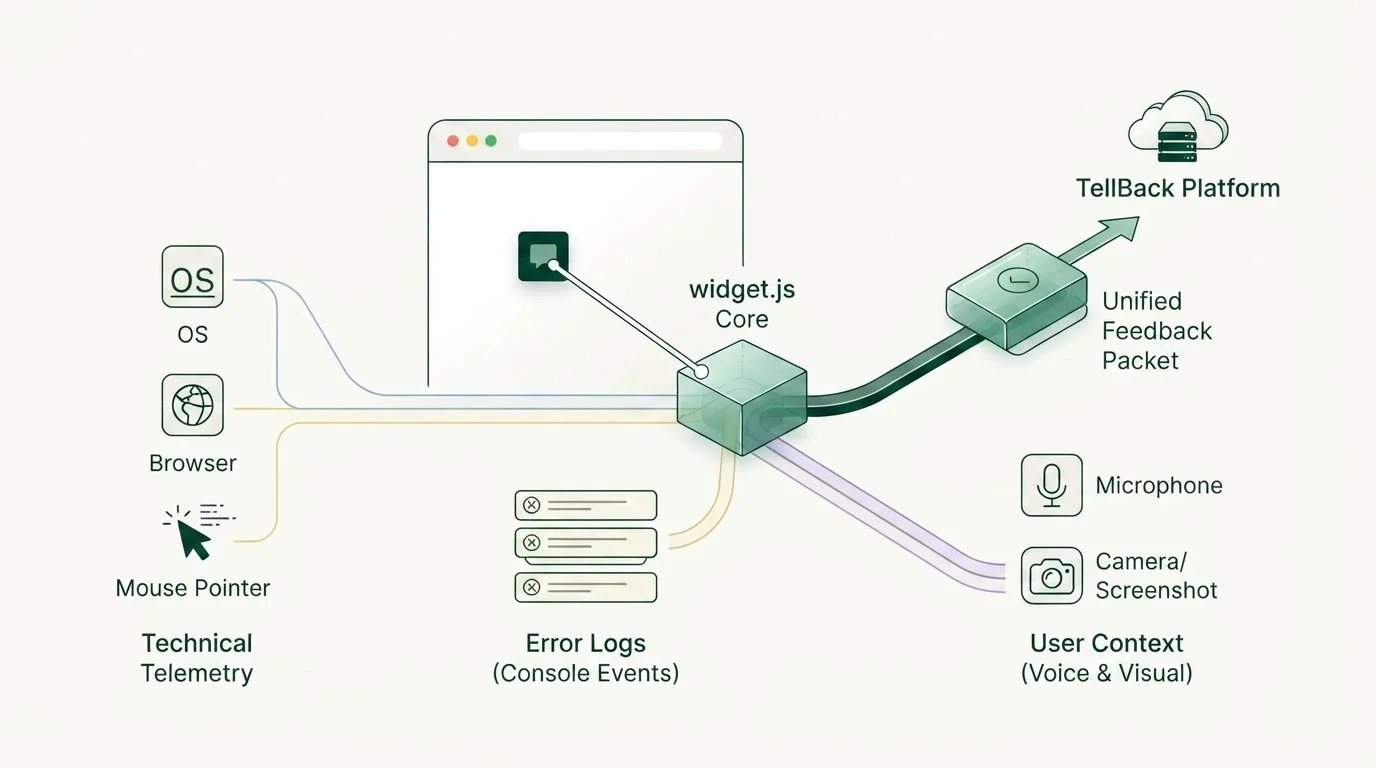
The effectiveness of AI analysis is entirely dependent on the quality of the input data. TellBack utilizes a client-side JavaScript snippet, widget.js, to capture a comprehensive technical snapshot whenever feedback is submitted. This includes clicks, scroll timelines, device specifications, browser metadata, and JS console error events recorded during the session.
By capturing safe error context and technical telemetry, the system provides the AI with the raw materials needed to generate a high-fidelity task. Users can also record voice notes directly within the feedback widget. These audio reports offer verbal nuance that text often lacks, helping developers understand the user's specific workflow and the exact moment friction occurred without needing to save separate transcript files.
From Messy Feedback to Dev-Ready Tasks
The core innovation of the TellBack approach is the transformation of raw feedback into dev-ready tasks. By integrating with Generative AI—specifically utilizing Gemini models via Vertex AI—the platform parses messy visitor input into structured documentation. This isn't just a summary; it is a technical blueprint for a fix.
Every AI-generated task includes the technical context necessary for a developer to begin work immediately. This includes the OS, browser version, and any console errors recorded during the session. By automating this documentation, the platform eliminates the need for developers to manually recreate the environment or hunt for missing details. This automated triage keeps developers in the flow of shipping code rather than gathering data.
Get the latest on feedback intelligence
Stay informed on the latest in feedback intelligence, bug reporting, and product development strategies. Learn to transform messy signals into clear tasks.
Optimizing for AI Coding Agents
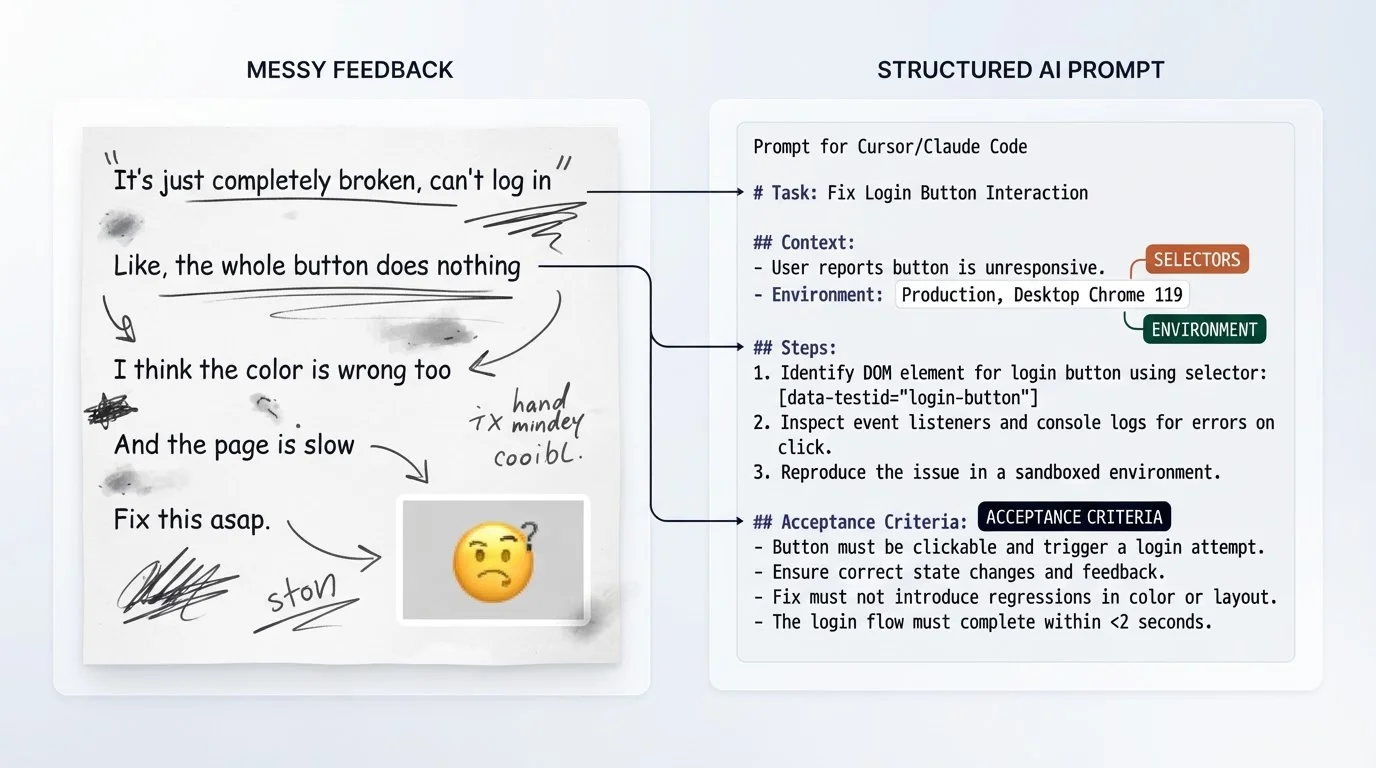
As the development workflow shifts toward the use of AI coding assistants, the requirements for a "good" task description have changed. TellBack meets this demand by drafting markdown-formatted prompts specifically designed for agents like Cursor, Claude Code, or Windsurf.
These prompts include selectors, visual evidence, and clear acceptance criteria. A developer can copy the AI-generated prompt directly into their IDE, providing the coding agent with all the context it needs to generate a code fix. This zero prompt-writing workflow significantly reduces the time between identifying a bug and shipping a resolution, as the coding agent is given a perfectly structured starting point with all necessary technical metadata.
Impact on Product Roadmapping and Prioritization
AI-driven feedback analysis provides a data-driven foundation for product roadmapping. Instead of prioritizing features based on the loudest voices, product managers can use aggregated sentiment and frequency data to identify the most impactful improvements. TellBack supports this by offering baseline feedback items and detailed session records that highlight exactly where users are struggling.
For teams managing high-traffic applications, the platform enforces specific duration caps and rate-limits to maintain client application performance. This ensures that the feedback collection process never degrades the user experience. By having a clear, categorized view of all incoming feedback, teams can move from reactive firefighting to proactive product enhancement, ensuring that every development sprint adds maximum value to the end user.
Scaling for Agencies and Enterprise Teams
The needs of a freelance developer differ significantly from those of a large agency or enterprise team. TellBack offers a tiered structure to ensure that teams of all sizes can access AI-powered feedback intelligence. The Freelance plan focuses on individual builders, while the Studio plan caters to growing product teams that require collaborative triage capabilities across multiple seats.
For firms managing a large portfolio of clients, the Agency plan offers unlimited projects, allowing developers to manage feedback and bug reports for multiple clients from a single workspace. Enterprise-level operations can further leverage advanced features such as Single Sign-On (SSO), Service Level Agreements (SLA), and custom Data Processing Agreements (DPA).
Higher-tier configurations also provide access to webhooks, client portals, and dedicated engineering support. These tools ensure that the feedback system integrates seamlessly with existing enterprise security and compliance standards while offering full white-label configurations for a professional client-facing experience.
Frequently Asked Questions
Q: How does AI feedback analysis differ from traditional bug reporting?
Traditional bug reporting relies on manual input from users, which is often incomplete. AI feedback analysis automatically captures technical context like console logs and browser metadata, then uses NLP to categorize and summarize the issue into a structured task.
Q: What coding agents does TellBack support?
TellBack generates markdown prompts specifically optimized for AI coding agents such as Cursor, Claude Code, and Windsurf, including the selectors and evidence needed for the agent to work effectively.
Q: Is user privacy protected during feedback collection?
Yes. TellBack allows for granular control over data collection. You can choose to collect page views only, hidden sessions, or full feedback on a per-site basis, and enterprise plans include custom Data Processing Agreements (DPA).
Q: Can I use TellBack for multiple client projects?
Yes. The Agency plan offers unlimited projects, allowing agencies to manage feedback and bug reports for multiple clients from a single workspace.
Q: Does the feedback widget support audio input?
Yes. Users can record and submit voice notes directly within the widget, providing verbal explanations that complement screenshots and technical telemetry.
The transition to AI-driven feedback analysis is a necessary evolution for teams shipping modern software. By moving away from context-poor reports and embracing a structured intelligence layer, product teams can drastically reduce resolution times and improve product quality. TellBack provides the bridge between user friction and technical execution, offering the context, parsing power, and agent-ready prompts required to lead in a competitive market. Embracing these tools ensures your development cycle remains fast, data-driven, and focused on building what users actually need.